Aka a first-principles approach at building my future, while avoiding getting stuck at a local minimum.
The TL;DR
- Doing something is generally better than coasting along, unless you’re running in the completely wrong direction.
- Certain doors close as you get older and your risk tolerance declines.
- Therefore, I should make a really thoughtful attempt at setting a trajectory (whether a single bet, or some distribution of my efforts). Then run at it with full force, cushioned against temporary setbacks by the fact that I made a thoughtful and deliberate choice.
The details
What I’m currently doing.
I all too often find myself guilty of making career choices based solely on what’s in front of me. Like a newbie chess player looking 1 step ahead and looking for the incrementally best solution.
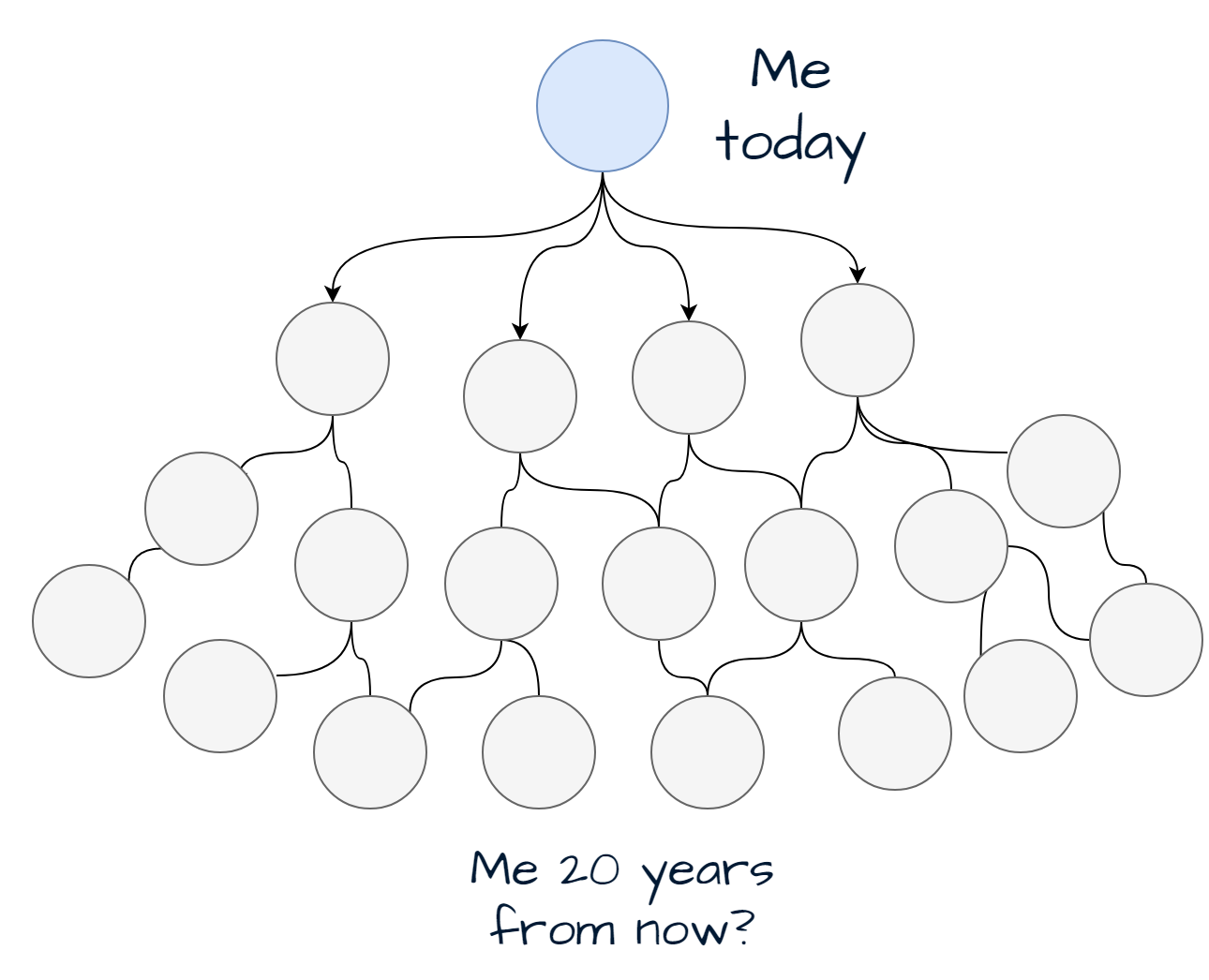
From that standpoint, my approach to career progression has followed a pretty simple algorithm.
A. Arrive at my role and get cozy. Spend some time learning and getting reasonably competent.
B. List available options for next step along trajectory. Mostly by looking at different things people in your current position went on to do as their immediate next step.
C. Evaluate each option based on how much it aligns with your goals and your probability of success.
D. Learn the requisite skills that align with 1-2 preferred next steps. Then when an opportunity presents itself (or when sufficiently frustrated by current role) make the jump.
E. Repeat steps A-D ad infinitum.
Crucially, this means often taking an incrementally better opportunity that arrives on your doorstep even if a lower probability bird-in-the-bush is better aligned with your ideal long term outcome.
The end result is a path that looks kinda weird each time you look back at it and requires regularly rewriting the narrative of “how did I get here.”

This approach does deliver steady incremental improvement. But it also carries a few big risks:
- You don’t develop as much expertise as people that pick a thing and stick with it.
- Doors start to close as you go up. Paths that otherwise seem more aligned with your strengths and aspirations feel harder to commit to if they require stepping back in terms of authority or compensation.
- You can easily find yourself at the end wondering “why the fuck am I here.”
What I think I should be doing.
What I’d love to do instead is a top down approach. The new, shiny, proposed algorithm:
A. Look at all the “end nodes.” Narrow it down to things that seem at least remotely possible.
B. Prioritize end nodes based on how much they align to a set of parameters for what I find important, as well as attainability (probability of getting there + alignment with strength/weakness profile).
C. Pick a node.
D. Plot the most efficient path to get there, based on speed + probability.
E. Stick to that path, embracing the fact that progress will feel much less incremental.

Parameters for prioritizing
| Parameter | Multiplier |
|---|---|
| Stuff that matters | |
| Enjoyment - How much do the mental loops I make overlap with the mental loops I enjoy doing (e.g. SQL >>> slide decks or sales) | 7 |
| Fulfillment - The “How eager am I to tell a stranger about what I do” factor. | 9 |
| Solving the money problem - All else equivalent, I’d rather have a home in the Bay than a suburb in Georgia. | 6 |
| Stuff that doesn’t matter | |
| Physical Location - Quickly becoming less relevant in a remote work future | 3 |
| Optionality - Probably irrelevant when thinking about end states. | Approaches 0 with time |
| Social good - Probably attainable through means other than just your career. | 2 |
Strengths/weaknesses
| Weaknesses | Threats | Mitigants |
|---|---|---|
| Generally less technical than a freshman engineering student | Harder (but not impossible) to prototype things than as a dev | Plenty of people have gone far up either the leadership or tech entrepreneurship track without knowing how to program |
| Somewhat poor at self-motivation / project management | Projects done in isolation tend to stall | Team up with people that have complementary skillsets |
| Bad at reading people, and the skills that come with it: sales, navigating hierarchies | Progressing up the corporate ladder at higher stages might become more challenging | Stay in tech |
| Robust generalist - with limited depth of expertise in any particular space | Deeply technical roles feel more challenging to reach | Find something interesting/aligned enough that I can stick around long enough to become an expert |
| Strengths | Opportunities |
|---|---|
| Generally personable - good at leading small teams, also deeply enjoy this style of work. | Career pace may actually improve when I’ve attained a role in technical leadership |
| Technical enough to make basic prototypes / engage with engineers. Humble enough to respect the expertise of people that know more than I. | Can at least make a proof of concept with no funding or dev support |
| Robust generalist - mediocre but more informed than the average person across everything from UX design, to analytics, to hardware. | Useful skillset for enterprises that have not scaled yet, or will never scale to the level of hiring experts in those respective areas. |
Theoretical end-nodes
| End node | Paths to get there | Feasibility | Enjoyment | Fulfillment | Comp | Score |
|---|---|---|---|---|---|---|
| High-power IC / Expert in some specific area | Build my way up within tech; get hyper-focused | 3 | 3 | 6 | 4 | 30 |
| C-something in analytics or product | Build my way up within established tech | 2 | 4 | 8 | 5 | 26 |
| Grab onto something that looks like a rocketship and hold on | 4 | 7 | 6 | 6 | 55 | |
| Launch something | 1.5 | 5 | 9 | 7 | 24 | |
| Owner/cofounder/proprietor of a “lifestyle” tech business | 2 | 5 | 7 | 7 | 29 | |
| Launch or take over something more traditional (real estate, local small biz, etc) | Honestly no idea. | 2 | 4 | 7 | 8 | 29 |
| Partner back in consulting | Pivot back into consulting leveraging SF skillset | 1 | 1 | 5 | 8 | 11 |
Score = (Feasibility/10) * Σ(Param Value * Param Multiplier)